Period VII , Mehrgarh, Balochistan, Pakistan
2700-2500 BCE. Thermoluminescence analysis CIRAM - 4200 years old (±400 years)
Height: 9 inches (22.75 cm)
Provenance: Joel Greene - San Francisco, CA
CIRAM report included - click here to view
For nearly a century, our knowledge of ancient South Asian civilization was confined to the remarkably advanced Indus Valley cities of Harappa and Mohenjo Daro, which seemingly emerged quite suddenly, without a clear evolutionary timeline. The last fifty years, however, have fundamentally shifted this perspective, with the 1974 discovery of the Neolithic site of Mehrgarh filling the crucial missing gap in our understanding of the pre-Indus period. Located in Balochistan, Pakistan, this extraordinarily rich archaeological site provides the direct link between the early rustic Neolithic settlements of these pioneering farmers and herders, and the subsequent highly developed agrarian societies of the Indus Valley, ushering in the urban revolution and its far-reaching consequences.
First arising from semi-nomadic groups in 7000BCE, Mehrgarh offers the earliest evidence of agriculture, cattle domestication, and complex, sustained craft. This important proto-historic site was discovered by the French Archaeological Mission, led by the distinguished archaeologists Jean-François Jarrige and his wife, Catherine Jarrige. Located on the Kacchi Plain near the Bolan Pass—a vital prehistoric route connecting the Iranian Plateau and Central Asia with the Indus Valley—the Mehrgarh site covers a vast 750 acre (300-hectare) area. The French Archaeological Mission, in collaboration with the Department of Archaeology of Pakistan, undertook a massive, 25-year excavation project spanning from 1975 to 2000. Excavations across six major mounds yielded over 32,000 artifacts, revealing successive, continuous habitation over millennia, with the extensive, multi-layered strata revealing a fascinating record of cultural evolution.
Early Mehrgarh residents lived in rectangular mud brick houses, stored their grain in community granaries, fashioned tools with local copper ore, and lined their large basket containers with bitumen. They cultivated six-row barley, einkorn and emmer wheat, jujubes and dates, and herded sheep, goats and cattle. Residents of the later period (5500 BCE to 2600 BCE) dedicated much time to various crafts, including flint knapping, metalworking, sophisticated ceramic figurines and pottery, and bead production, among others. It is remarkable the variety of early civilizational technologies that can be traced back to Mehrgarh, whether it is the earliest cotton fabric known in the subcontinent, the first wheel-thrown pottery, steatite seals, the earliest evidence of surplus granary storage structures, as well as the oldest known example of the lost-wax technique, evidenced by a remarkable 6,000-year-old wheel-shaped copper amulet found at Mehrgarh.
The oldest ceramic figurines in South Asia were also to be found at Mehrgarh. They occur in all phases of the settlement and were prevalent even prior to the first appearance of pottery. The earliest figurines were quite simple and were modeled without intricate features. However, the figurines grew in sophistication with time, and by 4000 BCE they began to show their characteristic thin waists and broad hips, complex hairstyles and typical prominent breasts. The corpus of figurines up to this period were entirely female, with male figurines appearing later, beginning during period VII in 2500 BCE and gradually become more numerous. Many of the female figurines are portrayed holding infants and were initially interpreted as depictions of a mother goddess. Increasingly, scholars have challenged this interpretation, citing the fact that the Mehrgarh female figurines have been portrayed with great diversity and are often depicted performing everyday tasks, indicating perhaps that many of the figurines were modelled on real women of households and were related more to domestic rituals and shamanistic practices rather than an established organized religion.
The exceptional Mehrgarh terracotta seated female figurine presented here is very closely related to female figurines recovered at Mehrgarh’s Chhalgarhi mound in the Kachhi Plain, and is one of the rare complete examples in this category. She is portrayed with a characteristic bald head, incised eyes and eyebrows, and delicately modeled ears, nose and mouth. The narrow waist extends to prominent breasts framed by broad shoulders from which emerge outstretched bent arms and finely modeled clenched hands positioned as if to grasp, and research has suggested that certain figurines from Mehrgarh were originally designed to hold or interact with objects, such as tiny offerings, organic textiles, or wooden tools—that have since decayed. The cylindrical legs are suspended from a seated position and terminate in finely modeled feet. A most striking and rare feature of this figurine is the retention of its red carnelian inlays, still secured and intact within the eye sockets. Excavations at Mehrgarh have revealed that a number of the figurines once held inlays comprised of shell and semi-precious stones, as evidenced by surviving impressions left within the surface of the eye sockets. Carnelian was used extensively at Mehrgarh, dating back to 4000 BCE, primarily for crafting jewelry and personal ornaments and represents one of the earliest known examples of advanced lapidary work in the region. Beyond its aesthetic appeal, the use of carnelian…often associated with red, blood-like colors, likely held symbolic value related to protection, vitality, or status within the Neolithic community and suggests this figurine may have a held a special religious significance. This figurine, like the majority of examples from Mehrgarh, features a white slip, applied as a thin external coating before firing. Comprised of mined mineral deposits or a preparation of crushed powdered bones, the white slip served to enhance the figurines visual appearance, providing a pale finish that served as a base for additional pigments, of which only traces remain.
INQUIRE HERE
Period VII , Mehrgarh, Balochistan, Pakistan
2700-2500 BCE. Thermoluminescence analysis CIRAM - 4200 years old (±400 years)
Height: 9 inches (22.75 cm)
Provenance: Joel Greene - San Francisco, CA
CIRAM report included - click here to view
For nearly a century, our knowledge of ancient South Asian civilization was confined to the remarkably advanced Indus Valley cities of Harappa and Mohenjo Daro, which seemingly emerged quite suddenly, without a clear evolutionary timeline. The last fifty years, however, have fundamentally shifted this perspective, with the 1974 discovery of the Neolithic site of Mehrgarh filling the crucial missing gap in our understanding of the pre-Indus period. Located in Balochistan, Pakistan, this extraordinarily rich archaeological site provides the direct link between the early rustic Neolithic settlements of these pioneering farmers and herders, and the subsequent highly developed agrarian societies of the Indus Valley, ushering in the urban revolution and its far-reaching consequences.
First arising from semi-nomadic groups in 7000BCE, Mehrgarh offers the earliest evidence of agriculture, cattle domestication, and complex, sustained craft. This important proto-historic site was discovered by the French Archaeological Mission, led by the distinguished archaeologists Jean-François Jarrige and his wife, Catherine Jarrige. Located on the Kacchi Plain near the Bolan Pass—a vital prehistoric route connecting the Iranian Plateau and Central Asia with the Indus Valley—the Mehrgarh site covers a vast 750 acre (300-hectare) area. The French Archaeological Mission, in collaboration with the Department of Archaeology of Pakistan, undertook a massive, 25-year excavation project spanning from 1975 to 2000. Excavations across six major mounds yielded over 32,000 artifacts, revealing successive, continuous habitation over millennia, with the extensive, multi-layered strata revealing a fascinating record of cultural evolution.
Early Mehrgarh residents lived in rectangular mud brick houses, stored their grain in community granaries, fashioned tools with local copper ore, and lined their large basket containers with bitumen. They cultivated six-row barley, einkorn and emmer wheat, jujubes and dates, and herded sheep, goats and cattle. Residents of the later period (5500 BCE to 2600 BCE) dedicated much time to various crafts, including flint knapping, metalworking, sophisticated ceramic figurines and pottery, and bead production, among others. It is remarkable the variety of early civilizational technologies that can be traced back to Mehrgarh, whether it is the earliest cotton fabric known in the subcontinent, the first wheel-thrown pottery, steatite seals, the earliest evidence of surplus granary storage structures, as well as the oldest known example of the lost-wax technique, evidenced by a remarkable 6,000-year-old wheel-shaped copper amulet found at Mehrgarh.
The oldest ceramic figurines in South Asia were also to be found at Mehrgarh. They occur in all phases of the settlement and were prevalent even prior to the first appearance of pottery. The earliest figurines were quite simple and were modeled without intricate features. However, the figurines grew in sophistication with time, and by 4000 BCE they began to show their characteristic thin waists and broad hips, complex hairstyles and typical prominent breasts. The corpus of figurines up to this period were entirely female, with male figurines appearing later, beginning during period VII in 2500 BCE and gradually become more numerous. Many of the female figurines are portrayed holding infants and were initially interpreted as depictions of a mother goddess. Increasingly, scholars have challenged this interpretation, citing the fact that the Mehrgarh female figurines have been portrayed with great diversity and are often depicted performing everyday tasks, indicating perhaps that many of the figurines were modelled on real women of households and were related more to domestic rituals and shamanistic practices rather than an established organized religion.
The exceptional Mehrgarh terracotta seated female figurine presented here is very closely related to female figurines recovered at Mehrgarh’s Chhalgarhi mound in the Kachhi Plain, and is one of the rare complete examples in this category. She is portrayed with a characteristic bald head, incised eyes and eyebrows, and delicately modeled ears, nose and mouth. The narrow waist extends to prominent breasts framed by broad shoulders from which emerge outstretched bent arms and finely modeled clenched hands positioned as if to grasp, and research has suggested that certain figurines from Mehrgarh were originally designed to hold or interact with objects, such as tiny offerings, organic textiles, or wooden tools—that have since decayed. The cylindrical legs are suspended from a seated position and terminate in finely modeled feet. A most striking and rare feature of this figurine is the retention of its red carnelian inlays, still secured and intact within the eye sockets. Excavations at Mehrgarh have revealed that a number of the figurines once held inlays comprised of shell and semi-precious stones, as evidenced by surviving impressions left within the surface of the eye sockets. Carnelian was used extensively at Mehrgarh, dating back to 4000 BCE, primarily for crafting jewelry and personal ornaments and represents one of the earliest known examples of advanced lapidary work in the region. Beyond its aesthetic appeal, the use of carnelian…often associated with red, blood-like colors, likely held symbolic value related to protection, vitality, or status within the Neolithic community and suggests this figurine may have a held a special religious significance. This figurine, like the majority of examples from Mehrgarh, features a white slip, applied as a thin external coating before firing. Comprised of mined mineral deposits or a preparation of crushed powdered bones, the white slip served to enhance the figurines visual appearance, providing a pale finish that served as a base for additional pigments, of which only traces remain.
INQUIRE HERE


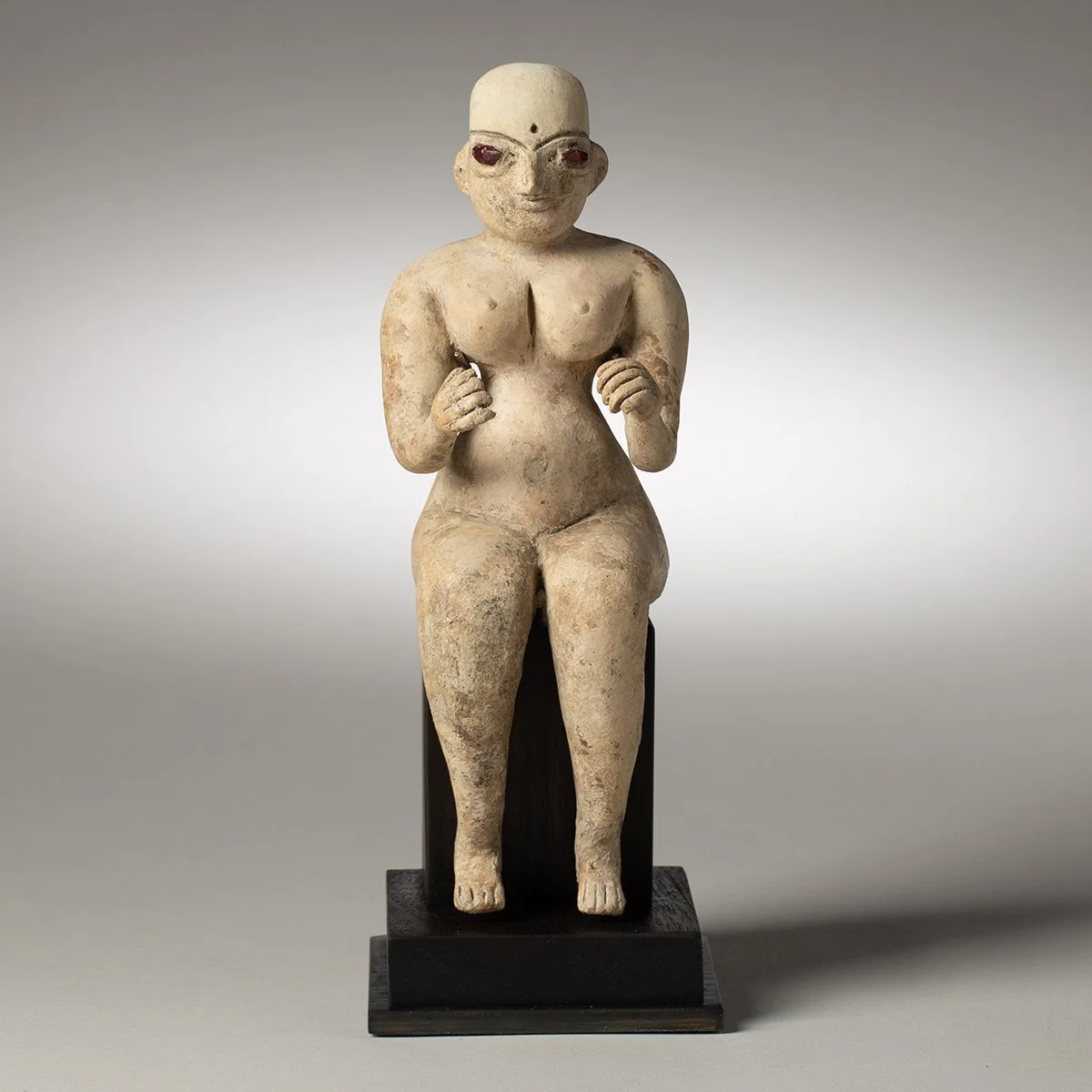 Image 1 of 6
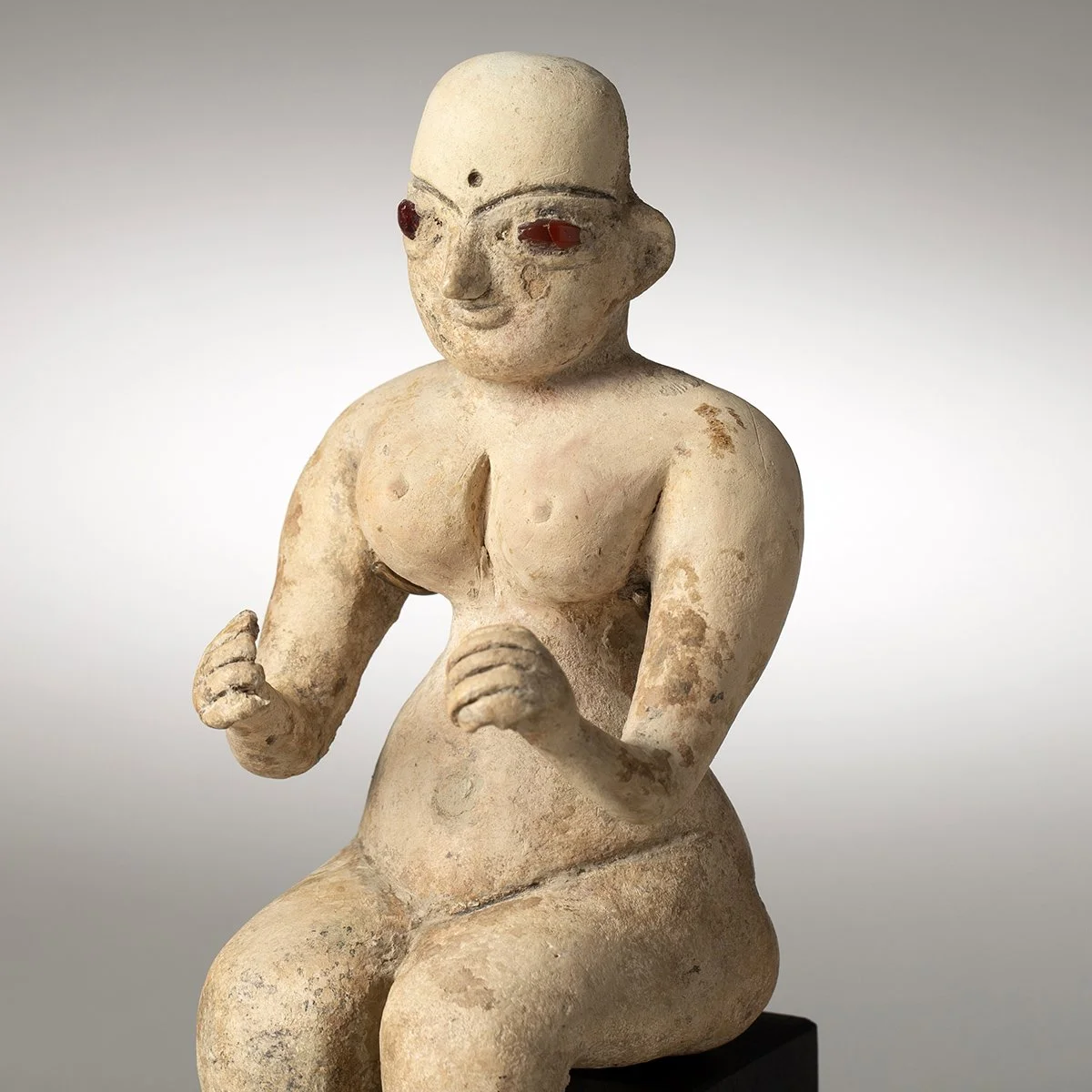 Image 2 of 6
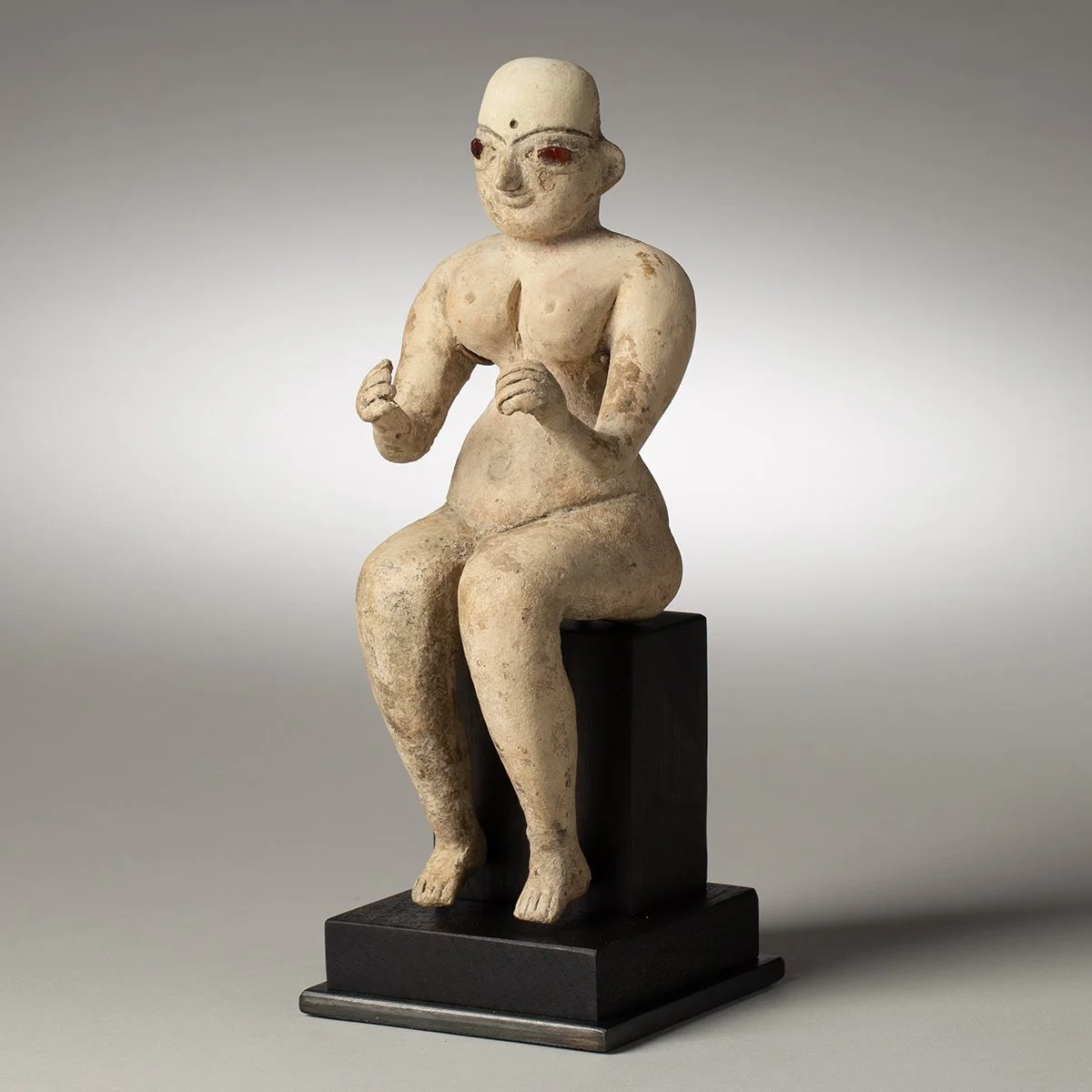 Image 3 of 6
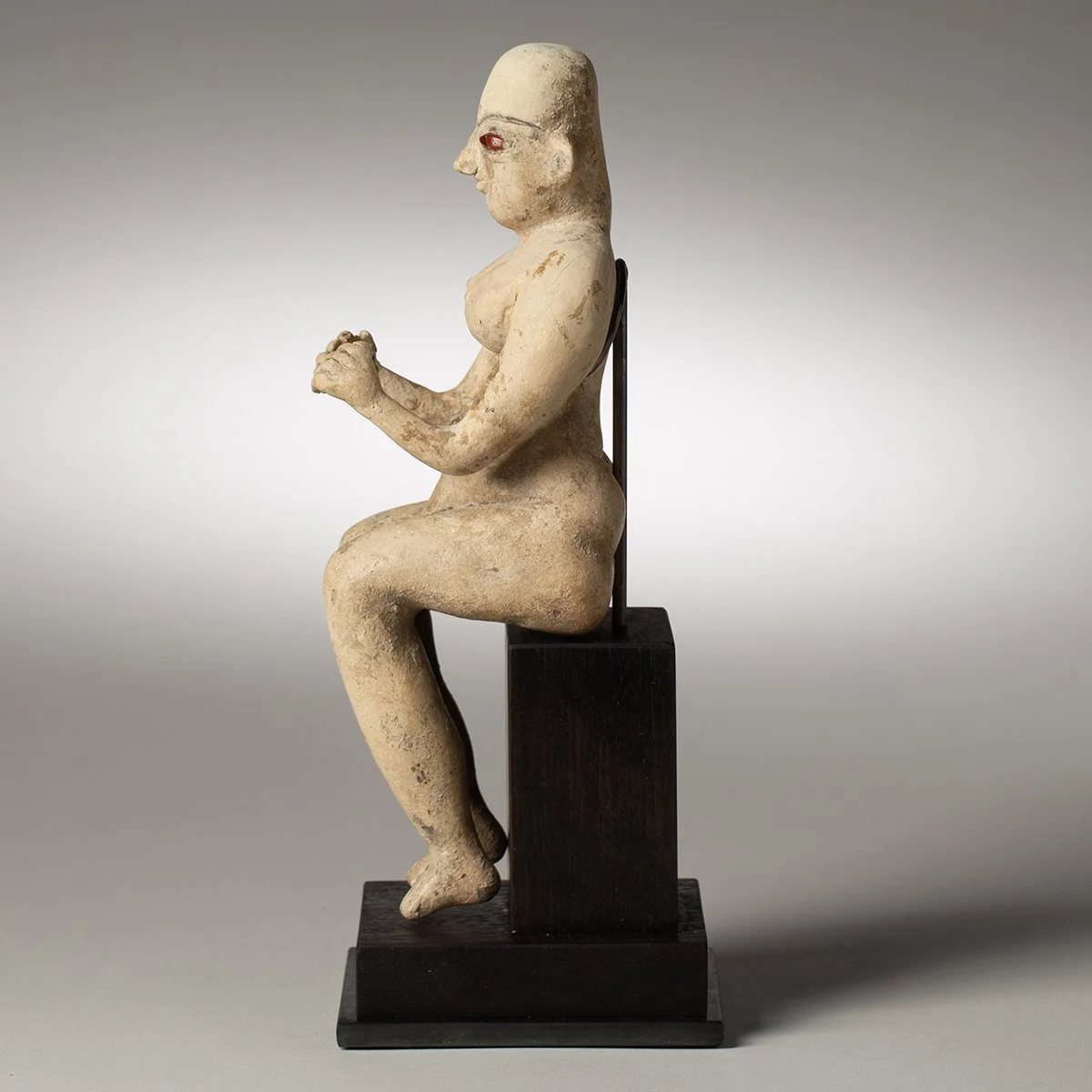 Image 4 of 6
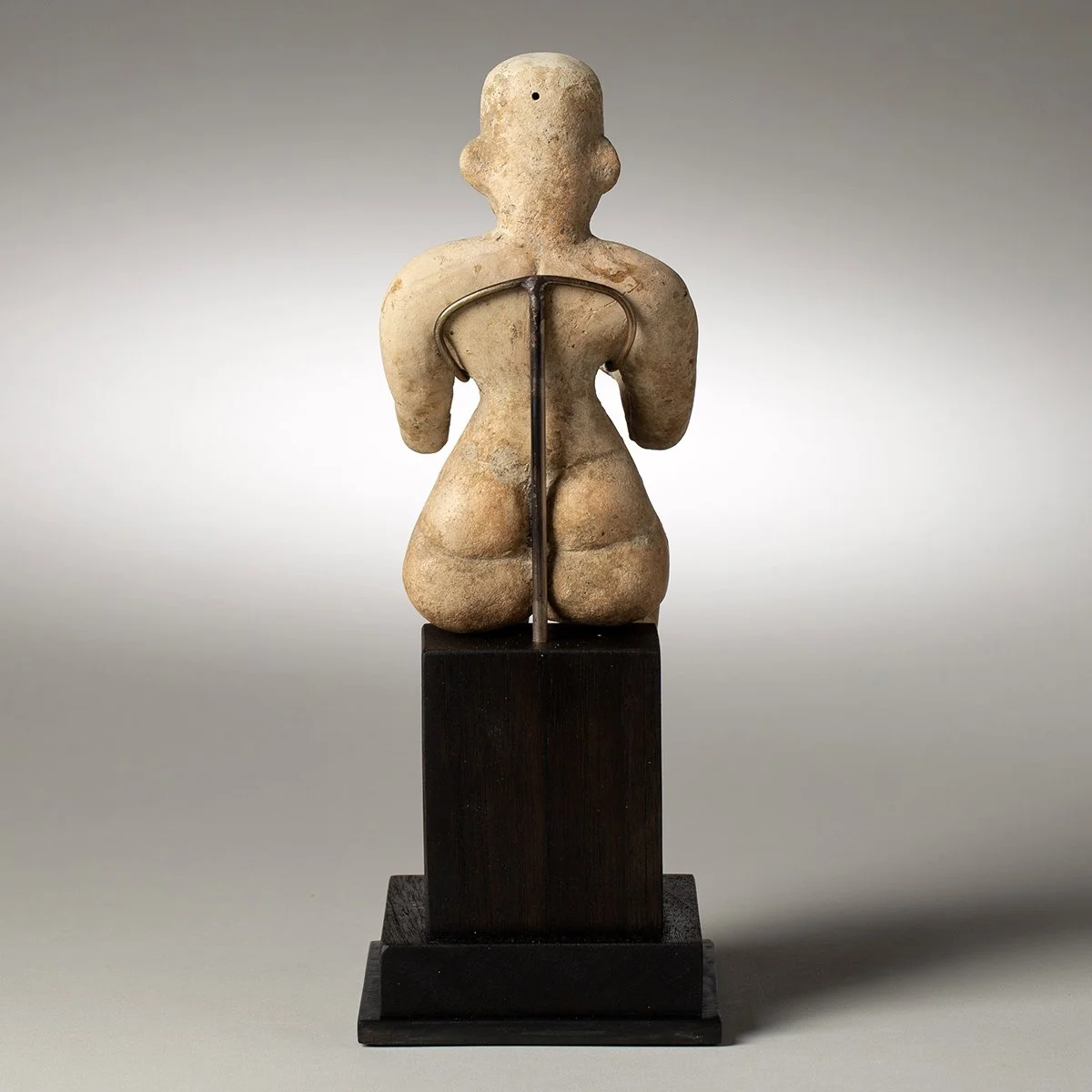 Image 5 of 6
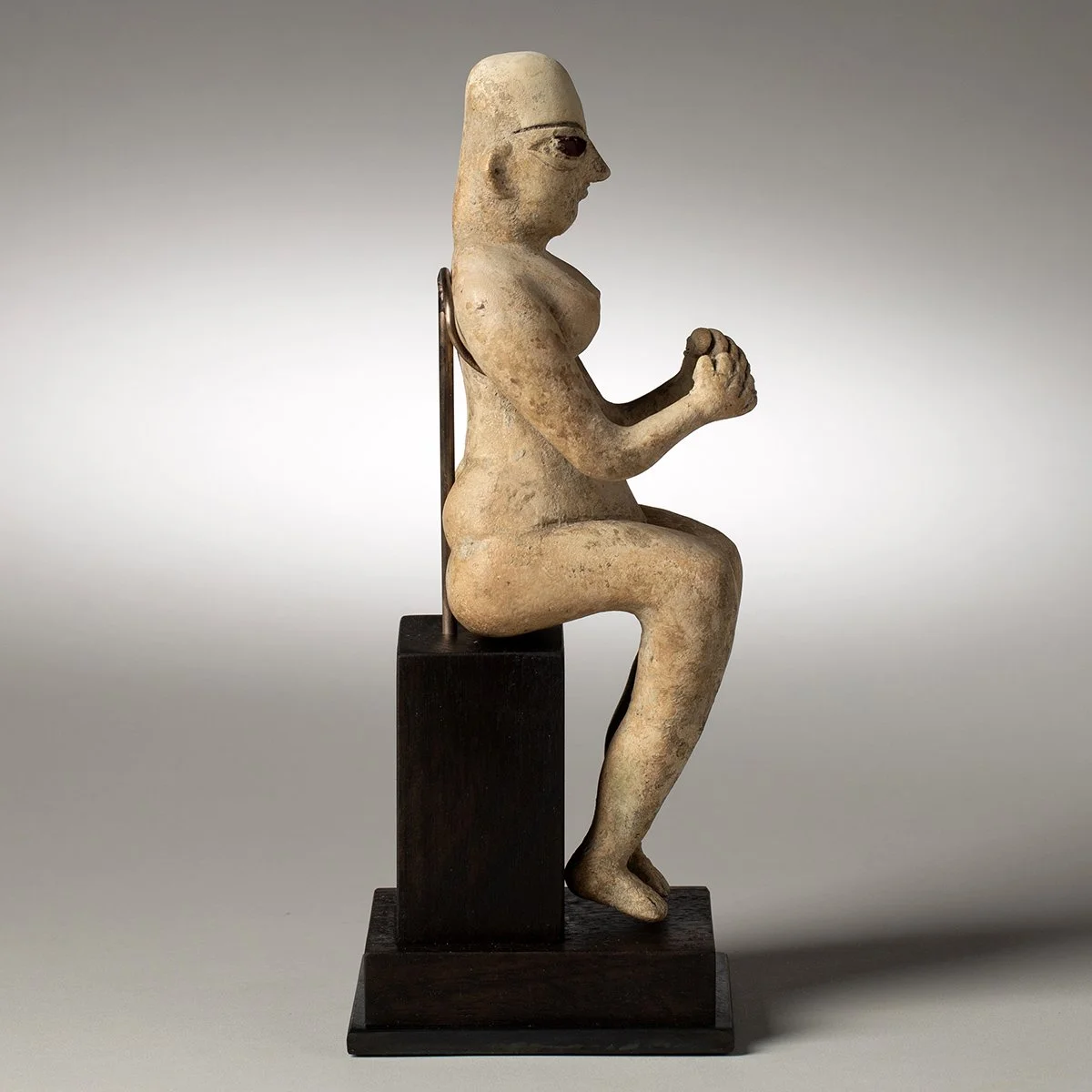 Image 6 of 6