Middle Sepik River, Papua New Guinea
Early 20th century
Height: 29.5 inches (75 cm)
Provenance: Field collected in 1982 in Kambian village / Private collection – Sydney, Australia,
The distinctive Mei masks of the Iatmul people of the Middle Sepik region are characterized by oblong faces with elongated noses that often merge into arch-like forms that join the nose to the chin or extend below it. These masks represent the founding ancestral brothers and sisters of a village clan. Each clan owns a pair, and when not in use, they are kept suspended in the clan elder's house. Related to head- hunting and to warfare, the masks appear and are danced in pairs, with the longer thinner mask representing the male and the shorter larger one the female. This supernatural Mei couple symbolizes duality, a principle that organizes many Sepik River societies among the Iatmul and the neighboring Sawos language groups. Attached to a conical basketry costume which covers the dancer’s head and upper body, the masks are painted in native black, white, and red ochre pigments and are sometimes further decorated with cowrie shells inlayed into a clay and resin base.
Mei mask performances begin with the construction of a fenced compound. Within it, the men build a raised platform, with a backdrop depicting the mountains where, according to oral tradition, the masks originated, and a ramp that extends over the wall to the ground outside. As the performance begins, the Mei masked dancers burst from behind the backdrop and stride down the ramp. Reaching the ground outside, they are joined by the women, who accompany them to the dancing ground, where a lengthy performance ensues before the dancers finally retire into the men’s ceremonial house.
The fine and elegantly carved mask presented here represents the male aspect of the supernatural Mei couple. The long aquiline nose is finely rendered and joins an extended curved element called a molot that continues downward to join the chin, terminating with a charming ancestral avian head. Pierced on the chin are a pair of attachment holes intended to help secure the mask to its accompanying basketry framework. The ears are also pierced for ceremonial adornments as is the septum and the deeply arched eyes are inset with cowrie shells. The mask bears traces of red ocher, black charcoal, and white lime pigments, still visible beneath the dark and warm glossy patina resulting from the mask’s many decades stored within the community men’s house. The mask was field collected in 1982 in Kambian village, one of the smaller peripheral villages that comprise Yamok village in the Sawos region of the Middle Sepik. The mask originates though from Sortmeri, a Iatmul village along the main Sepik River. It was brought to Kambian village in the 1920’s by the great-grandfather of the owner, a man named Flau. The personal name of the mask was “Ombaligaui”.
INQUIRE HERE
Middle Sepik River, Papua New Guinea
Early 20th century
Height: 29.5 inches (75 cm)
Provenance: Field collected in 1982 in Kambian village / Private collection – Sydney, Australia,
The distinctive Mei masks of the Iatmul people of the Middle Sepik region are characterized by oblong faces with elongated noses that often merge into arch-like forms that join the nose to the chin or extend below it. These masks represent the founding ancestral brothers and sisters of a village clan. Each clan owns a pair, and when not in use, they are kept suspended in the clan elder's house. Related to head- hunting and to warfare, the masks appear and are danced in pairs, with the longer thinner mask representing the male and the shorter larger one the female. This supernatural Mei couple symbolizes duality, a principle that organizes many Sepik River societies among the Iatmul and the neighboring Sawos language groups. Attached to a conical basketry costume which covers the dancer’s head and upper body, the masks are painted in native black, white, and red ochre pigments and are sometimes further decorated with cowrie shells inlayed into a clay and resin base.
Mei mask performances begin with the construction of a fenced compound. Within it, the men build a raised platform, with a backdrop depicting the mountains where, according to oral tradition, the masks originated, and a ramp that extends over the wall to the ground outside. As the performance begins, the Mei masked dancers burst from behind the backdrop and stride down the ramp. Reaching the ground outside, they are joined by the women, who accompany them to the dancing ground, where a lengthy performance ensues before the dancers finally retire into the men’s ceremonial house.
The fine and elegantly carved mask presented here represents the male aspect of the supernatural Mei couple. The long aquiline nose is finely rendered and joins an extended curved element called a molot that continues downward to join the chin, terminating with a charming ancestral avian head. Pierced on the chin are a pair of attachment holes intended to help secure the mask to its accompanying basketry framework. The ears are also pierced for ceremonial adornments as is the septum and the deeply arched eyes are inset with cowrie shells. The mask bears traces of red ocher, black charcoal, and white lime pigments, still visible beneath the dark and warm glossy patina resulting from the mask’s many decades stored within the community men’s house. The mask was field collected in 1982 in Kambian village, one of the smaller peripheral villages that comprise Yamok village in the Sawos region of the Middle Sepik. The mask originates though from Sortmeri, a Iatmul village along the main Sepik River. It was brought to Kambian village in the 1920’s by the great-grandfather of the owner, a man named Flau. The personal name of the mask was “Ombaligaui”.
INQUIRE HERE


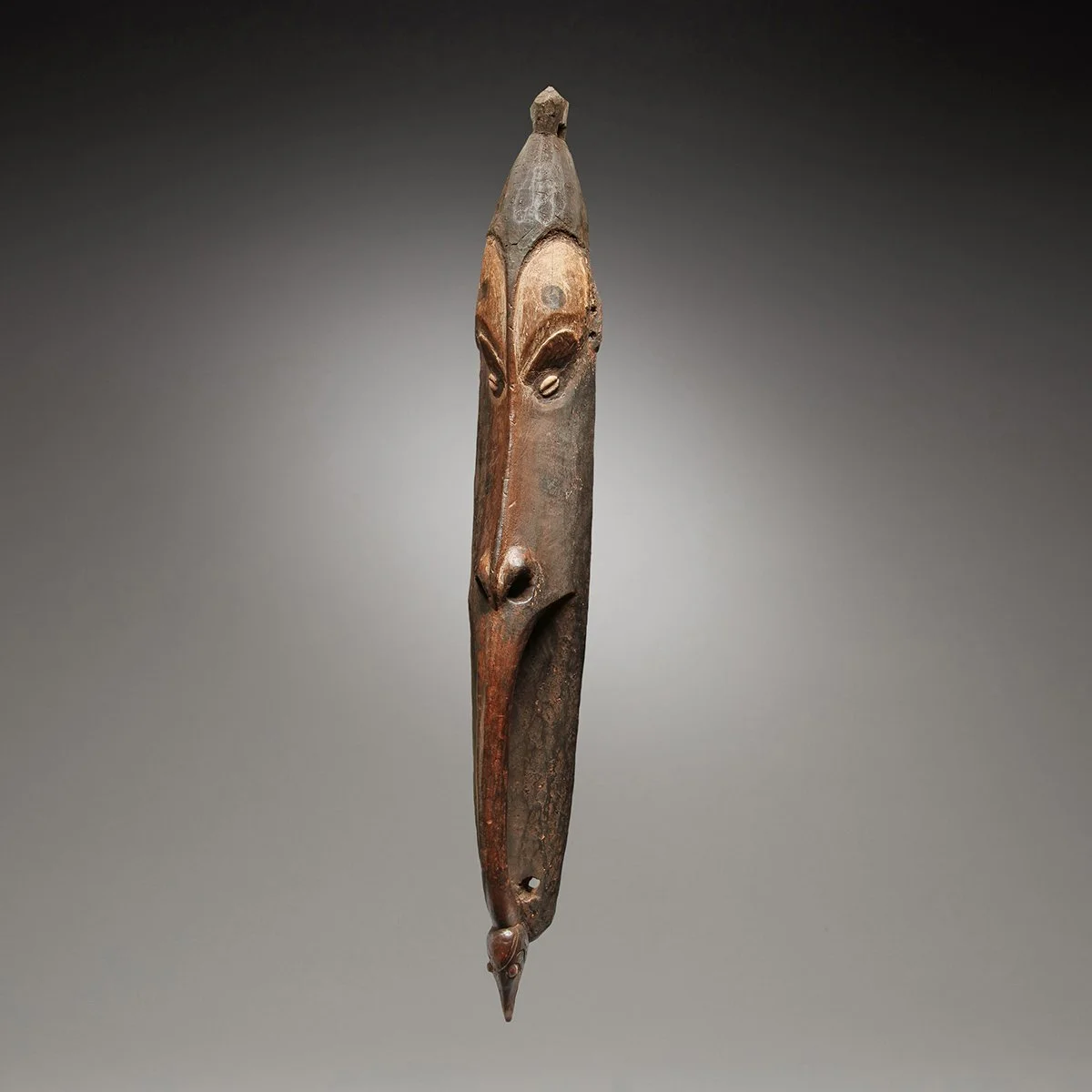 Image 1 of 6
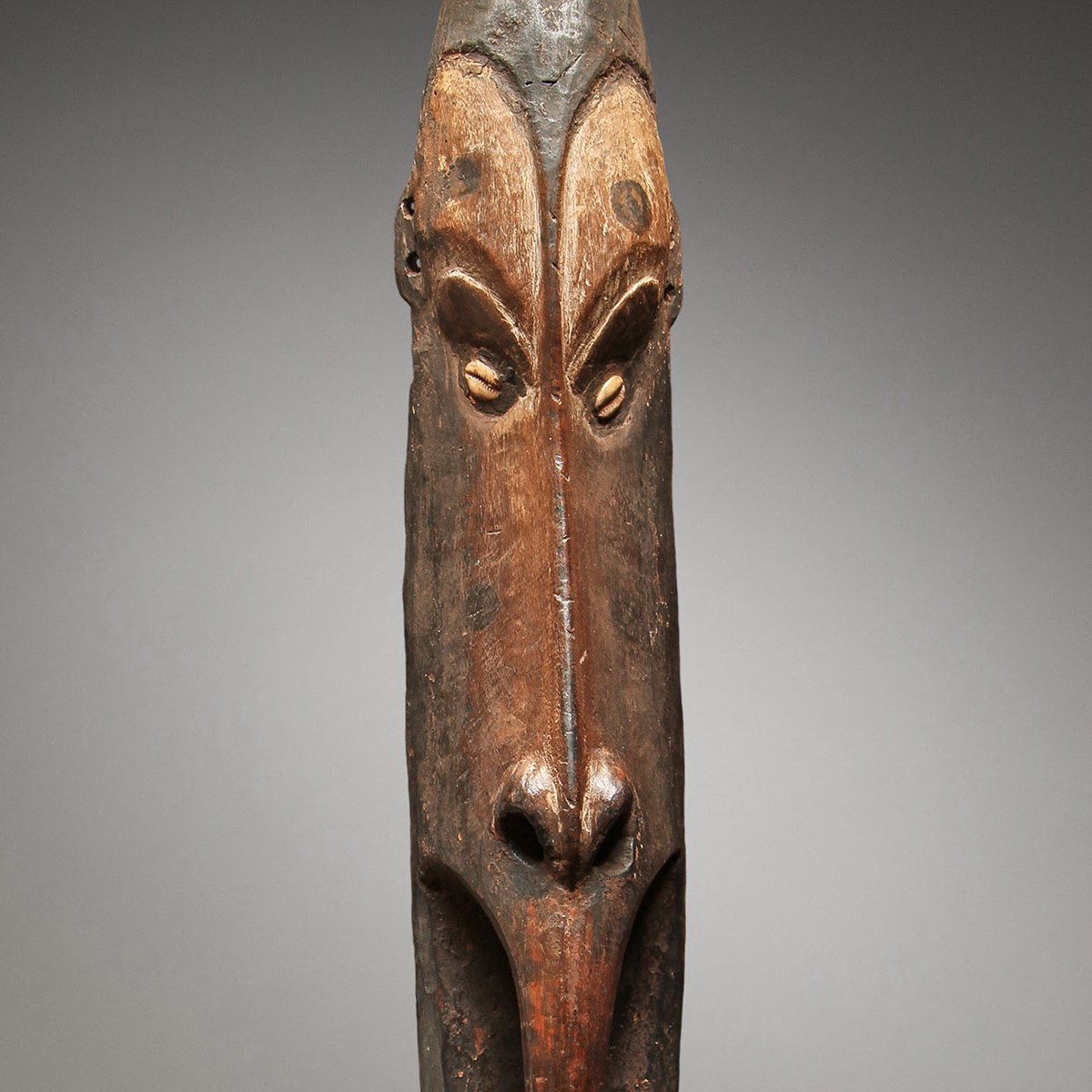 Image 2 of 6
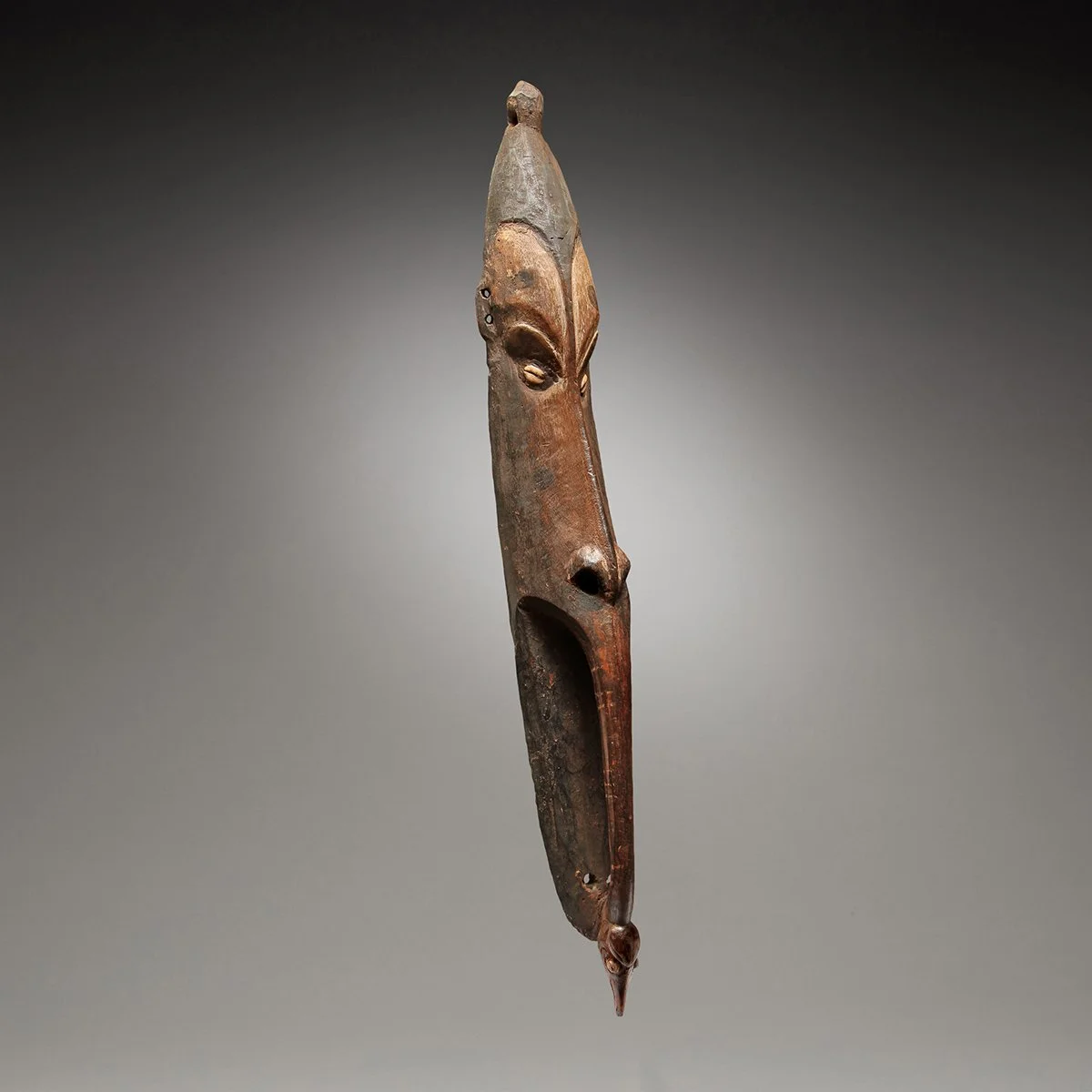 Image 3 of 6
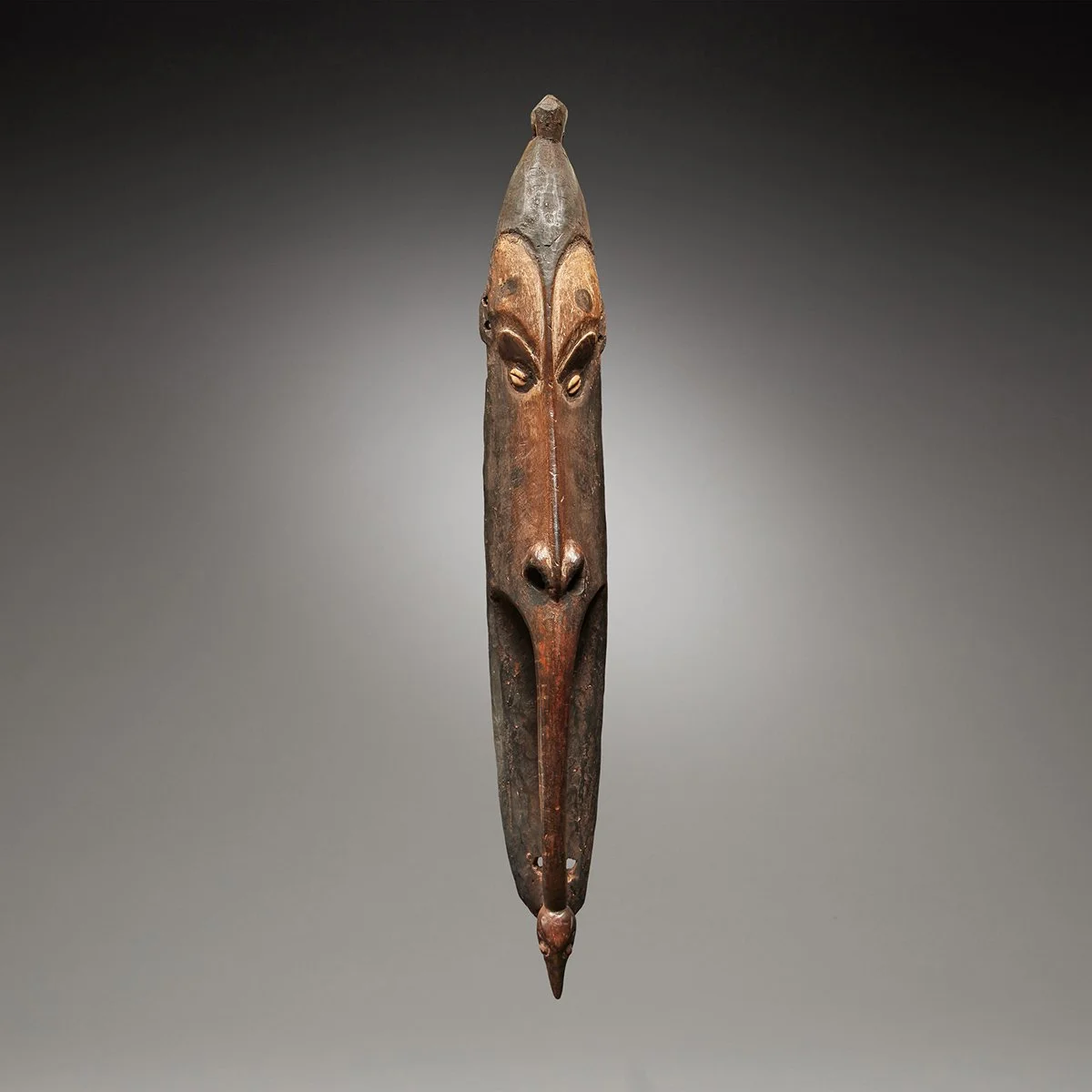 Image 4 of 6
 Image 5 of 6
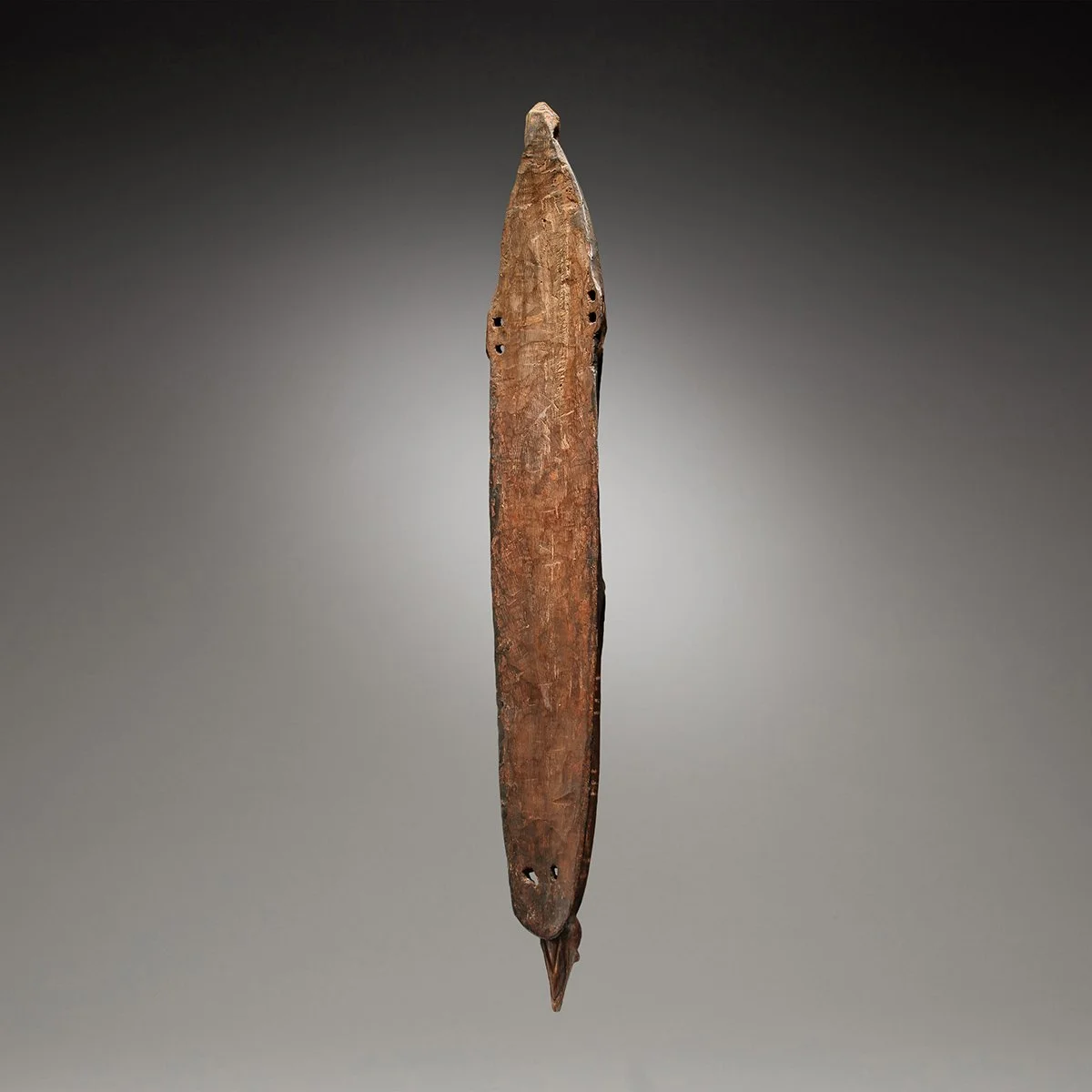 Image 6 of 6